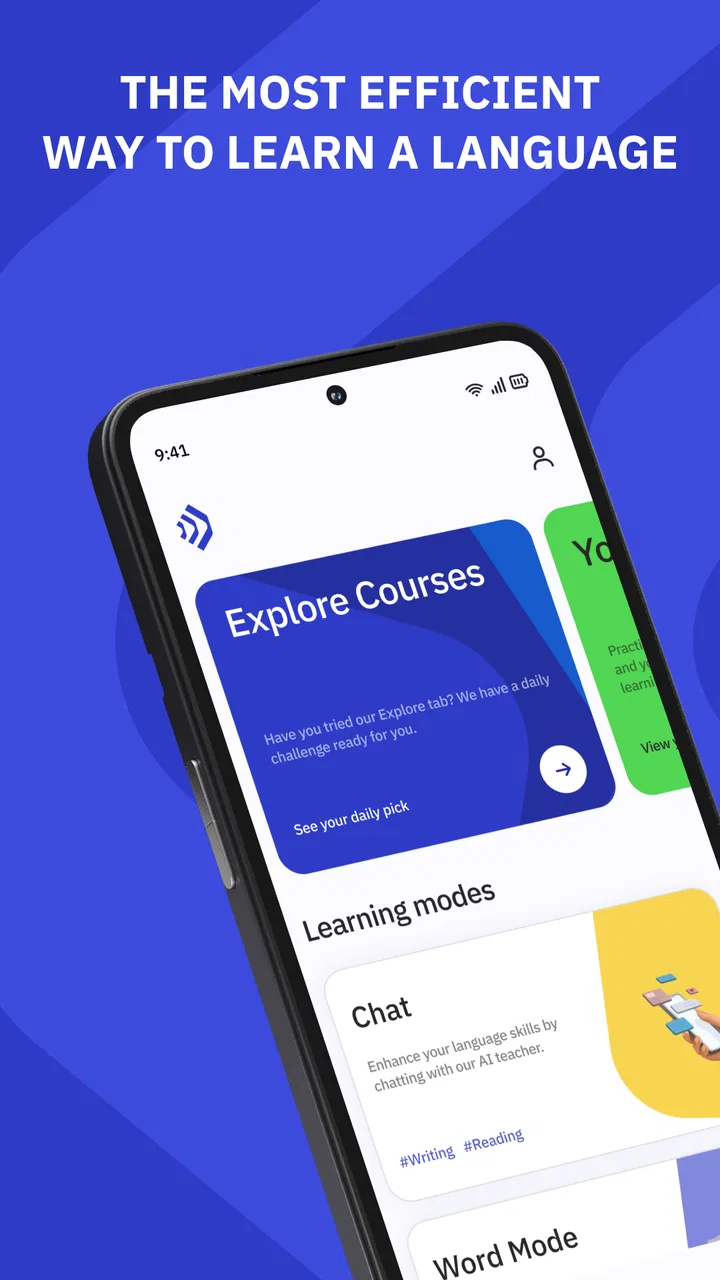
Talkpal - AI Language Learning
- 4.6
- Rating
- 5.00M
- Installs
- Free
- Price

 Analysis by App-foxy
I tried Talkpal as an everyday language-learning app rather than treating it like a quick vocabulary game, and that distinction matters. Its main appeal is the idea of practicing with an AI language tutor whenever I have a spare moment. Instead of waiting for a class partner or following only fixed exercises, I can use the app for conversational practice in a more flexible way. That makes it especially interesting for learners who understand written material but hesitate when they have to produce a sentence themselves.
Talkpal is an education app for AI-assisted language learning, developed by Talkpal, Inc. It is free to install, rated for Everyone, and its store presence shows more than a million installs with a 4.3 average from roughly sixty-three thousand ratings. Those figures suggest that it has moved beyond being a small experiment, although popularity alone does not guarantee that its teaching style will suit every learner.
The app supports English, Spanish, German, French, Italian, and more than eighty other languages. That breadth is useful if I am learning one language now but expect to study another later. At the same time, a large language menu can make the experience feel less focused than a dedicated app built around only one language. My overall impression is that Talkpal works best as a practice companion, particularly for speaking confidence, rather than as a complete replacement for a structured course, teacher, or serious grammar reference.
You May Also Like

 Blood Strike: 2.5 Anniversary
Blood Strike’s Loadouts Turn Every Drop Into a Tactical Gamble
A close look at Blood Strike’s custom loadouts: how fast access to signature weapons reshapes its battle royale rhythm, rewards preparation, and narrows the gap between fights.

 Pandora - Music & Podcasts
Pandora’s Music Is Easy to Start, but Harder to Recover
Pandora’s strength is its low-effort path from a seed to a station. Its weak spot is how much confidence it asks you to place in connection, setup, and quiet recovery.

 8 Ball Pool
 Is Built on Rivalries, Rematches, and Routine
A close look at the rivalries, rematches, shared routines, and unanswered safety questions that turn a quick pool match into a persistent mobile community.

 Samsung Music
’s Quiet Strength Is Playing What You Already Own
Its reach comes less from spectacle than from dependable access to a personal library. That simplicity is both the app’s strongest retention engine and its ceiling.

 AccuWeather: Weather Radar
AccuWeather Review: A Quick, Clear Forecast for Everyday Decisions
For everyday plans, the best forecast is the one you can understand quickly. AccuWeather makes rain timing, radar, and local conditions easy to act on, with a few trade-offs.

 Hill Climb Racing
Why Hill Climb Racing Still Turns Crashes Into One More Run
A tiny car, a bumpy hill and one more upgrade: Hill Climb Racing keeps resurfacing because its simple chaos makes every near-miss feel personal.
More From Our News Desk



How Talkpal feels in its current form
I find Talkpal most revealing when language practice has to fit around other people’s routines: one person can use a quiet moment to rehearse a conversation, while another can take a turn later rather than needing a shared lesson time. That flexibility can make a shared device useful, but it also makes it worth thinking through whose learning goals and account activity are being used. The next section looks at what the app feels like in ordinary use.
A conversation-first approach
The most important thing to understand is that Talkpal is not simply a digital flashcard deck with an AI label attached. The useful part is the opportunity to form responses, react to prompts, and keep a learning session closer to a real exchange. That changes the mental effort involved. With ordinary flashcards, I can recognize a word and still be unable to use it. A conversational tutor exposes that gap quickly.
I found this approach most valuable when I treated each session as a small speaking rehearsal. Rather than trying to cover a huge amount of material, I would choose a practical situation in my mind, such as ordering food, introducing myself, discussing a work task, or asking for directions. The benefit is not just memorizing a phrase. It is practicing how to retrieve language under a little pressure, which is exactly where many learners struggle.
There is also a useful difference between practicing with Talkpal and speaking with a human partner. An AI tutor is available without arranging a time, and I can repeat a basic exchange without feeling embarrassed. That makes it easier to work on weak areas privately. The trade-off is that an AI conversation does not fully reproduce the interruptions, unclear wording, accents, cultural reactions, or unexpected changes that happen with real people.
Where the app fits among language tools
I would place Talkpal between a traditional self-study course and an open-ended conversation service. A standard course is usually better at taking a beginner through a carefully ordered sequence of grammar and vocabulary. A human tutor is better at diagnosing why a sentence sounds unnatural and adapting explanations to the learner’s background. Talkpal sits in the middle: more interactive than passive study, but less dependable than expert instruction for subtle corrections.
Compared with flashcard-focused apps, its strongest advantage is active production. Compared with live tutoring, its strongest advantage is convenience and privacy. Compared with a general chatbot, its advantage should be the learning context: the interaction is intended to support language practice rather than answer unrelated questions. I would still use a general reference tool alongside it when I needed a precise grammar explanation, a pronunciation model, or confirmation from a reliable dictionary.
This comparison also explains who should skip it. If your main goal is exam preparation with a fixed syllabus, Talkpal may feel too open-ended unless you create your own study plan. If you already speak comfortably and need detailed professional editing, it may not provide enough specialist feedback on its own. And if you dislike speaking or typing responses, the central benefit of the app will be much less important to you.
A realistic daily routine
Imagine that I am learning Spanish and have ten minutes before a train arrives. I can use that short window to rehearse a conversation about checking into a hotel. I would begin with simple answers, notice which words I keep avoiding, and then repeat the exchange with slightly fuller sentences. Later that evening, I could revisit the same situation and try to answer without translating every thought from English first.
That workflow is more useful than randomly opening an app and tapping through a few exercises because it gives the session a purpose. I recommend keeping a small note of three things after each practice: one phrase that felt natural, one word I could not retrieve, and one sentence I want to say more accurately next time. Talkpal can provide the interaction, but I still need to turn that interaction into a repeatable learning habit.
A second practical use is preparation for a specific event. Before a trip, interview, presentation, or meeting, I could rehearse likely questions and answers. I would not treat the generated exchange as a guarantee of what another person will say, but it can reduce the initial shock of speaking. The key is to practice variations rather than memorize one perfect script, because memorized answers often collapse when the conversation takes an unexpected turn.
What the recent version tells me about its direction
The current release gives me a practical reason to assess the app as a continuing tool, not just a one-off AI experiment, while the best test remains whether I can return to a useful practice session without fuss. For household use, I would keep each learner’s chosen language and personal practice distinct rather than treating one person’s conversation history as a family study plan. The following section considers what the version context can—and cannot—tell me about its direction.
The current release context
Talkpal’s current version is 2.7.0, and the app was released on November 17, 2023. That gives the product a relatively recent starting point while still leaving enough time for it to develop beyond an initial launch concept. I see the version number as evidence that the app is being maintained and refined, not as proof that every language or conversation type has reached the same level of quality.
For someone already using an older build, the practical expectation should be continuity rather than a completely different product. The core reason to return remains AI-supported language practice. Updates in an app like this are most meaningful when they make conversations easier to start, responses more useful, or the learning flow less distracting. I would judge the update experience by those everyday details instead of assuming that a higher version number automatically means a major teaching breakthrough.
The minimum operating-system requirement is Android 7.0, which keeps the app accessible to people using older Android devices. That is helpful for learners who do not own a recent phone, although the experience can still depend on the device’s performance and the quality of its connection. An app built around interactive AI needs more patience when a response takes time, especially if I am trying to practice during a short break.
What changed for existing users in practical terms
For an existing user, the most important effect of continued development is likely to be a smoother routine rather than a new reason to study. If the app opens reliably and lets me get into a relevant conversation quickly, I am more likely to use it several times a week. That matters because language improvement usually comes from repeated retrieval, not from one long session followed by a month away.
I also think version changes should be evaluated by how well they support different levels. A beginner needs prompts that do not become overwhelming, while an intermediate learner needs enough freedom to move beyond rehearsed phrases. A useful AI tutor has to balance those needs. If prompts are too rigid, advanced users become bored; if they are too open, beginners may not know what to say. Talkpal’s long-term value will depend on how consistently it handles that tension across its many supported languages.
There is a subtle advantage for returning users who build their own themes. I can keep practicing the same topic at increasing difficulty: first a short answer, then a reason, then a follow-up question, and finally a correction of my original wording. This creates progression even when I am not following a formal unit sequence. It is one of the better ways to prevent AI practice from becoming a collection of disconnected chats.
Free access and the paid boundary
Talkpal is free to download, but it includes in-app purchases ranging from $14.99 to $89.99 per item. That means I would not recommend committing to a paid plan immediately. First, I would test whether the available access fits my preferred language, response style, and daily routine. The right question is not simply whether the app is inexpensive or expensive; it is whether I will use its interactive practice often enough to justify paying for expanded access.
This pricing structure also changes how I would compare it with free alternatives. Free videos, podcasts, dictionaries, and community exchanges can cover listening, vocabulary, and real conversation at little or no cost. They may require more effort to organize, while Talkpal’s value is convenience. If I only study occasionally, assembling free resources may be the better choice. If I repeatedly avoid speaking because arranging practice is difficult, the convenience of an AI tutor may be worth more to me than another passive resource.
I would also avoid using the paid version as my only source of correction. Even if an interaction feels fluent, I still want to verify important grammar, formal writing, and professional terminology elsewhere. AI practice is most useful when it increases the amount I actively produce, not when it becomes the sole authority for every language decision.
Where Talkpal still needs careful handling
I would be careful not to mistake a comfortable AI exchange for proof that every correction is right, especially when a learner is preparing language for school, work, or travel. In a shared setting, I would also agree on simple boundaries before handing over a device: who is practicing, what language they are using, and whether the session is meant for casual conversation or focused study. The next section weighs those cautions alongside age and trust.
AI fluency is not the same as teaching precision
The biggest limitation is built into the format. A smooth reply can sound convincing even when the explanation is incomplete or the correction does not reflect the exact nuance I intended. This is particularly important in languages where register, gender, politeness, regional vocabulary, or word order changes the meaning. I would treat the app’s suggestions as practice feedback, then confirm anything important with a trusted grammar source or a qualified teacher.
That does not make the app useless. It simply defines the correct role. Talkpal is strong at getting me to attempt language, try again, and notice where I hesitate. It is less suitable as a final judge in a formal letter, an academic assignment, a legal exchange, or a high-stakes professional presentation. The more serious the consequence of a mistake, the more valuable human review becomes.
Conversation freedom can become unfocused
Open conversation is motivating, but it can also produce a vague study session. I may spend several minutes discussing a comfortable topic while avoiding the grammar or vocabulary that causes trouble. To prevent that, I recommend setting one measurable target before opening the app: use past tense several times, ask follow-up questions, practice polite requests, or describe a process without switching languages.
Another useful technique is deliberate difficulty. After a comfortable exchange, I would ask for a variation that changes the setting, the speaker, or the level of formality. For example, a restaurant conversation can become a complaint about an incorrect order, or a casual introduction can become a workplace introduction. This reveals whether I learned a flexible pattern or merely remembered a safe response.
Short sessions are not automatically better, either. They are easier to maintain, but they can encourage shallow repetition. I would combine quick daily practice with one longer weekly review in which I collect recurring mistakes and turn them into fresh prompts. That combination gives Talkpal a clearer educational purpose than using it only when I happen to feel motivated.
Language coverage should not be judged as one uniform experience
The promise of more than eighty languages is attractive, especially for multilingual households or travelers with varied goals. However, I would not assume that every supported language offers the same depth, naturalness, or learning support. Major languages generally have more learning material available across the industry, while less commonly studied languages may require more patience and outside verification.
If I were choosing Talkpal for a less widely taught language, I would test several things before building my routine around it: whether the prompts feel natural, whether corrections explain the problem clearly, and whether the vocabulary matches the region or situation I care about. A broad catalog is useful, but the specific quality of my target language matters more than the headline number of choices.
Who should use it and what I would watch next
Talkpal is rated for Everyone, but I would still choose practice topics and supervision according to the learner’s age and maturity; an age label is not a substitute for family judgment. For adults sharing a device, clear turn-taking and separate expectations can prevent one person’s casual session from being mistaken for another’s learning record, without assuming the app provides family controls. I close by considering which households are likely to benefit and what I would watch as they use it.
The learners most likely to benefit
I would recommend Talkpal to a shy beginner who needs low-pressure practice, an intermediate learner who understands much more than they can say, or a busy traveler who wants rehearsals without scheduling a tutor. It is also useful for people who already use a textbook or course but need more opportunities to produce language. In that setup, the course supplies structure and Talkpal supplies repetition.
I would be more cautious for advanced learners seeking fine stylistic judgment, students following a strict examination curriculum, and professionals who need guaranteed terminology. Those users may still enjoy the app for warm-up conversations, but they should pair it with specialist resources. Someone who wants a purely passive experience should also look elsewhere; the app becomes valuable only when I actively answer, experiment, and revisit difficult areas.
What I would monitor as the product evolves
As Talkpal continues to develop, I would watch how clearly it separates casual conversation from deliberate instruction. The best future improvements would help learners understand why a correction matters, adjust difficulty without excessive setup, and build a visible path from repeated mistakes to targeted practice. I would also pay attention to consistency between popular and less commonly studied languages, because breadth is meaningful only when the experience remains dependable across the catalog.
I would look for better support around learner control as well. Being able to request slower exchanges, more formal wording, simpler explanations, or extra examples can make an AI tutor far more useful than one that merely keeps the conversation moving. The important distinction is whether new development helps me learn from an interaction, not just continue it.
My final view is positive but specific: Talkpal is a convenient way to turn spare minutes into active language practice, and its AI tutor concept is most convincing when I use it to overcome hesitation. It should not replace a teacher, a structured course, or careful reference material in every situation. Still, for a free education app with broad language support, a current version of 2.7.0, and a large existing user base, it offers a practical middle ground between isolated study and live conversation.
I would install it, test my target language with several realistic scenarios, and judge it after a week of consistent use rather than after one entertaining exchange. If I can identify recurring weaknesses and return to them deliberately, Talkpal becomes more than an AI chat: it becomes a repeatable speaking workout. That is the reason I would recommend it to a friend, with the reminder that its best results come from combining convenience with my own study plan and sensible fact-checking.
FAQs for Talkpal - AI Language Learning
01What is Talkpal and how does it work?
Talkpal is an AI-powered language learning app designed to help users improve their language skills. It uses advanced AI algorithms to simulate real-life conversations, providing users with interactive dialogues that enhance speaking, listening, and comprehension skills. The app personalizes lessons based on your progress, ensuring a tailored learning experience.
02Is Talkpal suitable for beginners?
Yes, Talkpal is suitable for learners at all levels, including beginners. The app offers a structured learning path that starts with basic vocabulary and gradually progresses to more complex conversations. Beginners can benefit from its intuitive interface and easy-to-follow lessons that build a strong foundational understanding of the language.
03What languages can I learn with Talkpal?
Talkpal supports a wide range of popular languages, including Spanish, French, German, Mandarin, and more. The app continuously updates its language offerings to include emerging languages and dialects, ensuring a diverse selection for learners. Check the app store description for the most current list of available languages.
04Does Talkpal require an internet connection?
Talkpal primarily requires an internet connection to access its vast library of interactive content and AI-driven features. However, it offers offline mode for certain lessons and exercises, allowing users to download content ahead of time and continue learning without interruption when offline.
05Are there any subscription fees or in-app purchases?
Talkpal offers a freemium model, where users can access basic features for free. However, a subscription is required to unlock premium features such as advanced lessons, personalized feedback, and additional languages. In-app purchases may also be available for specific language packs or specialized content.
Pros
- Engaging AI-driven conversations.
- Wide range of languages offered.
- User-friendly interface.
- Personalized learning paths.
- Offline mode available.
Cons
- Limited free content.
- Requires stable internet for updates.
- Some accents not accurately represented.
- Occasional AI comprehension errors.
- Subscription can be costly.

Talkpal - AI Language Learning
Gallery